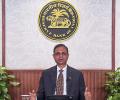
For the time being, the RBI is done with the cuts. A cut in October, which many are still predicting, is not certain. Of course, if growth nosedives, the script will be different, expects Tamal Bandyopadhyay.

Is the parabolic rise in silver running out of steam or just getting started? Ramalingam Kalirajan offers his take on if you should invest in silver now?

From the 30-share Sensex pack, Hindustan Unilever, NTPC, Nestle, IndusInd Bank, Power Grid, Adani Ports, Tata Motors and Bajaj Finserv were the major laggards. Reliance Industries, Kotak Mahindra Bank, Tech Mahindra, Mahindra & Mahindra and HDFC Bank were among the gainers.

Any reduction on purifiers would need consensus among state finance ministers.

Wholesale inflation fell to a 4-month low of 1.31 per cent in August due to a decline in prices of vegetables and fuel, even though onion and potato prices spiked, according to official data released on Tuesday. Wholesale price index-based inflation fell for the second straight month in August after it hit a high of 3.43 per cent in May. Inflation in July was 2.04 per cent. In August last year, WPI inflation was (-) 0.46 per cent.

Wholesale inflation in the country rose marginally to 0.53 per cent in March compared to 0.20 per cent in the preceding month due to increase in prices of vegetables, potato, onion and crude oil. The Wholesale Price Index (WPI)-based inflation was in the negative zone from April to October and had turned positive in November at 0.26 per cent. The inflation in March 2023 was 1.41 per cent.

From the Sensex basket, Mahindra & Mahindra, Larsen & Toubro, JSW Steel, NTPC, IndusInd Bank, Sun Pharma, UltraTech Cement, State Bank of India, Reliance Industries, and Maruti were the major gainers. Nestle, Tata Consultancy Services, Axis Bank, ICICI Bank, Bajaj Finance, ITC, and Asian Paints were among the laggards.
The wholesale inflation rose to a 13-month high of 1.26 per cent in April fuelled by rising prices of food articles, especially vegetables, amid expectations of RBI holding interest rates in the policy review next month. The wholesale price index (WPI) based inflation has been rising for two months in a row.

The wholesale price index (WPI)-based inflation eased in January to 0.27 per cent, mainly due to moderation in prices of food items. WPI inflation was at 0.73 per cent in December 2023. The WPI inflation was in the negative zone from April to October and had turned positive in November at 0.39 per cent.
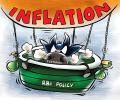
The Reserve Bank of India on Friday retained its projection for retail inflation at 4.5 per cent for the current fiscal assuming a normal monsoon, while emphasising that uncertainties related to food price outlook warrant a close monitoring. Consumer Price Index (CPI)-based retail inflation has been projected at 4.5 per cent with quarter-wise projections at 4.9 per cent in Q1 (April-June), 3.8 per cent in Q2, 4.6 per cent in Q3, and 4.5 per cent in Q4.

Finance Minister Nirmala Sitharaman's biggest challenge will be to find a new growth driver, particularly against the backdrop of a global economy ravaged by heightened uncertainty and fragmentation, financial markets on a precipice, and global commodity prices on a continued uptrend.

'...a mix of asset classes.' 'Include equities for growth (across market caps), debt for stability and liquidity, gold as a hedge against macro and currency risk, and global assets for geographical and economic diversification.'

'I will not be surprised if there is a 7 per cent handle in front of the decimal place for the full financial year.'

'People become guided by emotions, fear of missing out, and greed. They tend to invest in booming sectors that may prove exceptionally expensive.' 'Typically, that represents the peak, and subsequently, they lose substantially.'

Investing in gold trumped most other asset classes in terms of compounded annualised returns over the long term, suggests a report by FundsIndia.

A neutral monetary policy stance, heavy government borrowing, and issuers adjusting to a higher-for-longer yield environment have set the stage for a largely stable corporate bond market in 2026.

'For those in for the long haul, this is a God-given opportunity.' 'Your market is falling despite strong fundamentals, and such a clear roadmap has been announced.'

'We expect modest returns in 2026 versus the steep gains seen over the past few years.'

Wholesale price-based inflation rose to an eight-month high of 0.26 per cent in November, driven by a sharp jump in food prices, especially onion and vegetables. The WPI inflation was in the negative or deflationary zone for the past seven months since April and was at (-)0.52 per cent in October. The last positive WPI inflation was recorded in March at 1.41 per cent.

Sanjay Malhotra has made structural changes to banking regulation to bring down costs and increase efficiency. Plus, he kicked off a benign interest regime. But there are challenges ahead.
The Reserve Bank on Friday retained its inflation projection for current fiscal year at 6.7 per cent amid global geopolitical developments triggered by Russia-Ukraine war. RBI Governor Shaktikanta Das said the impact of inflation globally is weighing heavily on the domestic market. For September quarter of 2022-23, RBI projected retail inflation at 7.1 per cent.

The Reserve Bank on Friday raised the inflation projection for current fiscal year to 4.8 per cent from 4.5 per cent with Governor Shaktikanta Das saying lingering food price pressures are likely to keep headline inflation elevated in the December quarter. Consumer price index (CPI)-based inflation increased sharply in September and October 2024 led by an unanticipated increase in food prices.
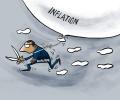
Wholesale price based inflation declined to a 3-month low of 1.89 per cent in November on cheaper food items, and experts predicted a 0.25 per cent interest rate cut by the RBI in the policy review in February. The Wholesale Price Index (WPI) based inflation was 2.36 per cent in October 2024. It was 0.39 per cent in November, last year. In August, 2024, it was 1.25 per cent.

The Reserve Bank on Friday retained inflation projection at 4.5 per cent for the current financial year, lower than 5.4 per cent in the last fiscal. Assuming a normal monsoon this year, CPI (consumer price index-based) inflation for the current year is projected at 4.5 per cent, with Q1 at 4.9 per cent, Q2 at 3.8 per cent, Q3 at 4.6 per cent, and Q4 at 4.5 per cent.

Food prices for consumers last month rose 12.16 per cent from a year earlier, slower than November's 14.72 per cent rise.

In a double delight, retail inflation eased to a one-year low of 5.72 per cent - staying below the upper tolerance limit for two months in a row, while factory output rose sharply to 7.2 per cent on the back of healthy growth in manufacturing. The retail inflation numbers based on Consumer Price Index (CPI) will provide some room for the Reserve Bank to further moderate the quantum of hike in key interest rate or even press a pause button. The RBI has been on a rate hiking spree since May 2022 in its bid to tame inflation, having raised the repo rate by a cumulative 225 basis points (bps).

Many individual states experienced higher inflation than the all-India figures during the financial year 2023-24 (FY24). Retail inflation figures in Telangana, Haryana, Rajasthan and Dadra and Nagar Haveli have been higher than national numbers every month of this financial year, shows a Business Standard analysis of state-wise figures, after the March inflation data was released on Friday. Experts noted that persistent high food inflation along with differences in the weights of rural and urban indices plays into the regional variation in inflation rates.

Wholesale inflation rate declined marginally to 0.2 per cent in February compared to 0.27 per cent in the preceding month despite a slight uptick in the food basket. The Wholesale Price Index (WPI)-based inflation was in the negative zone from April to October and had turned positive in November at 0.26 per cent. The inflation in February 2023 was 3.85 per cent.

The consolidated net profit of Marico, the maker of Parachute coconut oil, declined 0.7 per cent in the second quarter (July-September) of 2025-26 (Q2FY26).

Wholesale price inflation remained in the negative territory for the fourth month in a row in July at (-)1.36 per cent, even though prices of food items, especially vegetables, skyrocketed. The inflation, however, has inched up from (-)4.12 per cent recorded in June fuelled by 62.12 per cent rise in vegetable prices. In July last year, wholesale price index (WPI) was 14.07 per cent.

Former IPS officer Amar Singh Chahal allegedly shot himself after claiming he was duped of Rs 8.10 crore by cyber thugs. He was one of the accused in the 2015 police firing cases related to anti-sacrilege protests in Faridkot.
The wholesale price-based inflation eased to a 29-month low of 1.34 per cent in March on easing prices of manufactured products and fuel items, even though food articles turned expensive.
Wholesale price-based inflation rate fell to a 3-year low of (-) 3.48 per cent in May on easing prices of food, fuel and manufactured items, strengthening the case for continuing with the pause in rate hike in the coming months of the current fiscal. This is the second straight month when WPI has been in the negative zone mainly on account of a higher base and falling prices of fuel and manufactured goods. Food prices also eased during May. In May, 2022 WPI inflation was at 16.63 per cent. Last month, it was (-) 0.92 per cent.

So far this year, the rupee has fallen by 4.2 per cent, the worst among its Asian peers.
Retail inflation declined to a three-month low of 5.1 per cent in January, mainly due to subdued prices of vegetables, fruits and other food items, according to government data released on Monday. The fall indicates that retail inflation is inching towards the Reserve Bank's comfort level of 4 per cent. The Consumer Price Index (CPI) based inflation was on the rise for two straight months after touching a trough of 4.9 per cent in October 2023. In December, it stood at 5.69 per cent.

The finance ministry expects a broad-based moderation in inflationary pressures on the back of an anticipated reduction in food prices as a result of the uptick in summer sowing. The retail inflation rate remained stubbornly clung to the 5 per cent mark in seven of the past eight months. "Core inflation is trending downwards, indicating a broad-based moderation in price pressures... Driven by strong domestic growth and benign global commodity prices, core inflation is declining continuously.

The wholesale price-based inflation eased for the third consecutive month in August to 12.41 per cent, on softening in prices of manufactured items, even as food items saw an uptick. The Wholesale Price Index-based inflation was 13.93 per cent in July and 11.64 per cent in August last year. August is the 17th consecutive month of double-digit wholesale price inflation (WPI).
Snapping its declining trend, retail inflation rose to a three-month high of 5.55 per cent in November on firming food prices, including vegetables and cereals, though it remains within the RBI's comfort zone of less than 6 per cent. Inflation based on the Consumer Price Index (CPI) was 4.87 per cent in October and 5.88 per cent in November 2022, the government data released on Tuesday showed. The previous high was 6.83 per cent in August and inflation had been on a decline since then.

The Indian metal market is a promising sector to invest in as it provides a good balance between the prospects of growth and stability in dynamic economic conditions and a changing geopolitical environment. Metals such as gold, silver, copper, etc, have gained renewed significance in 2025, amidst growing inflation and India's push towards infrastructural growth and green energy initiatives.
The Indian metal market is a promising sector to invest in as it provides a good balance between the prospects of growth and stability in dynamic economic conditions and a changing geopolitical environment. Metals such as gold, silver, copper, etc, have gained renewed significance in 2025, amidst growing inflation and India's push towards infrastructural growth and green energy initiatives.
